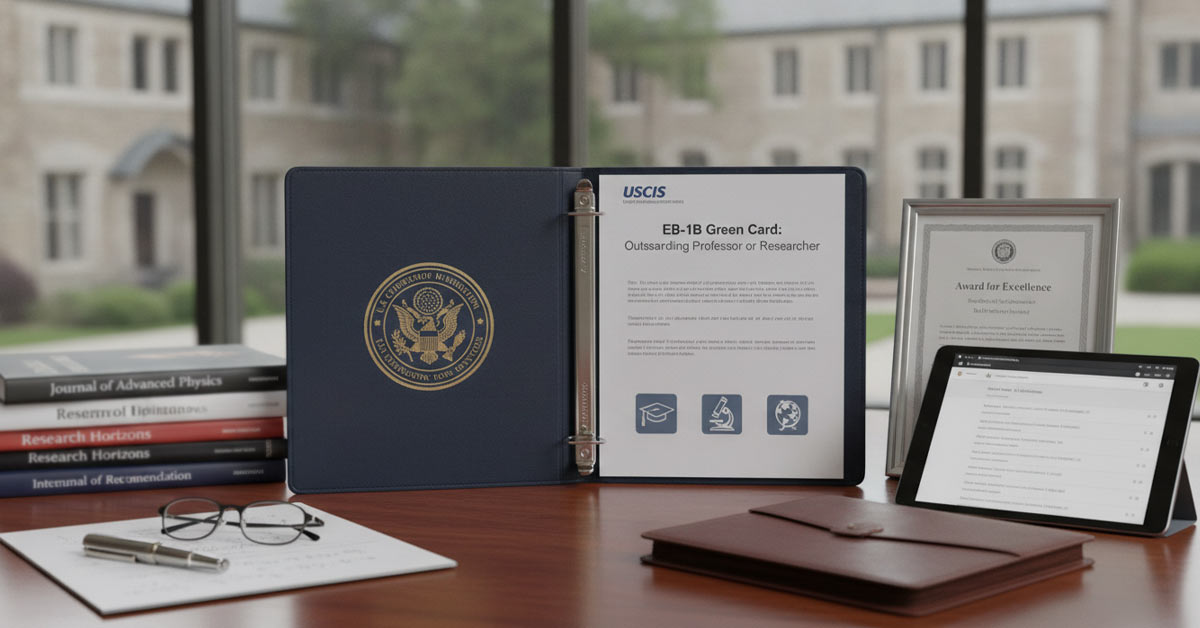

The EB-1B green card opens the first-preference path to permanent residence in the US for professors and researchers recognized internationally as outstanding in an academic field. Two things make the category attractive: it needs no PERM labor certification, and when built correctly the process moves fast. This guide covers how the EB-1B is built around the officer's question: the three threshold requirements, proving two of six criteria, the permanent-position test, the employer's role, the timeline, and the common denial reasons. We summarize who qualifies and the attorney support on our EB-1B green card attorney service. It is general information, not legal advice.
What Is the EB-1B Green Card?
The EB-1B is an employment-based first-preference category grounded in Section 203(b)(1)(B) of the immigration law and the 8 CFR 204.5(i) regulation. The measure is not being in the small percentage at the very top of your field, but being recognized internationally as outstanding in your field. Two qualities define the category. First, it is employer-based: you need a US institution to hire you and a permanent position, and you cannot self-petition. Second, it is exempt from the PERM labor certification; because it is a first preference, the employer does not have to run the months-long Department of Labor labor-market test before filing the I-140.
The Three Threshold Requirements: Recognition, Experience, a Permanent Position
The EB-1B requires all three threshold requirements together. First, being recognized internationally as outstanding in a specific academic field; recognition only within the US or Türkiye is not enough, and the evidence must show visibility that crosses borders. Second, at least three years of experience in teaching or research; years spent during a doctorate count only if the degree was completed and the teaching carried full classroom responsibility or the research was recognized as outstanding, so post-doc years usually count. Third, a US employer offering you a permanent position. A permanent position can take one of three forms: a tenured or tenure-track teaching post at a university, a comparable permanent research position at the same kind of institution, or a comparable research position at a private employer that employs at least three full-time researchers and has documented achievements in the field.
The Permanent-Position Test: What Counts
Permanence is an often-overlooked but decisive part of the file. Under the regulation, a permanent position is one that is tenured, tenure-track, or of indefinite duration and carries an expectation that employment will continue unless there is good cause otherwise. A temporary appointment, an adjunct teaching role, or a limited-duration fellowship does not count on its own. On the private-sector route, two extra conditions apply: the employer must prove that it employs at least three full-time researchers in the field and that it has documented achievements in the field. For Turkish researchers in industrial research and technology, the third employer type is a valuable door; but the permanence of the offer must be shown clearly by contract.
Two of Six Criteria and the Evidence File
To show international recognition, you must document at least two of six regulatory criteria. The criteria are: major prizes received for outstanding achievement in your field; membership in associations that require outstanding achievements of their members; published material in professional publications written by others about your work; participation as a judge, individually or on a panel, of the work of others in the same or an allied field; original scientific or scholarly research contributions to the field; and authorship of scholarly books or articles in journals with international circulation. Watch a common mistake: the third criterion asks for material others have written about you, while your own articles satisfy not that criterion but the sixth. If a standard criterion does not fit your occupation, you may submit comparable evidence by explaining why.
Meeting two criteria does not by itself mean approval. USCIS evaluates the file, under the framework set out in its Policy Manual, in two stages. In the first stage, the officer checks whether the two required criteria are met with evidence. In the second stage, all the evidence is weighed as a whole and, under the preponderance-of-the-evidence standard, the officer decides whether you are truly recognized internationally as outstanding in your field. Most denials happen at that second, holistic stage even though two criteria are met on paper. A winning file does not check boxes; it puts an independent, third-party source behind each piece of evidence.
The Employer's Role, the I-140, and the PERM Exemption
In the EB-1B, the petition is filed by the employer, not the employee. The employer files Form I-140 and documents its financial ability to pay the offered wage from the priority date onward. The category's most concrete advantage shows here: because it is a first preference, no PERM labor certification is required, so the months-long labor-market test that the EB-2 and EB-3 require is skipped. But the PERM exemption does not mean no employer is needed; the EB-1B always involves an employer sponsor and a permanent job offer. The only first-preference branch open to self-petition is the EB-1A extraordinary ability category, which needs no employer.
Timeline, Premium Processing, and the Visa Queue
The timeline depends on two variables: the I-140's processing time and the availability of a visa number. Premium processing is available for the I-140, and for the EB-1B the guaranteed window is 15 business days, meaning USCIS issues a decision within that time; the fee is $2,965 as of March 1, 2026. For those born in Türkiye the EB-1 queue is current on the State Department's July 2026 Visa Bulletin, meaning a visa number is available and an applicant in the US can file the I-140 and I-485 at the same time. Because the Visa Bulletin status can change month to month and has retrogressed only for those born in China and India, we assess the current picture based on your file. An applicant abroad uses consular processing with the DS-260. Your family is part of the process too: your spouse and unmarried children under 21 receive green cards alongside you as derivatives.
EB-1B, EB-1A, and EB-1C: Choosing the Right Route
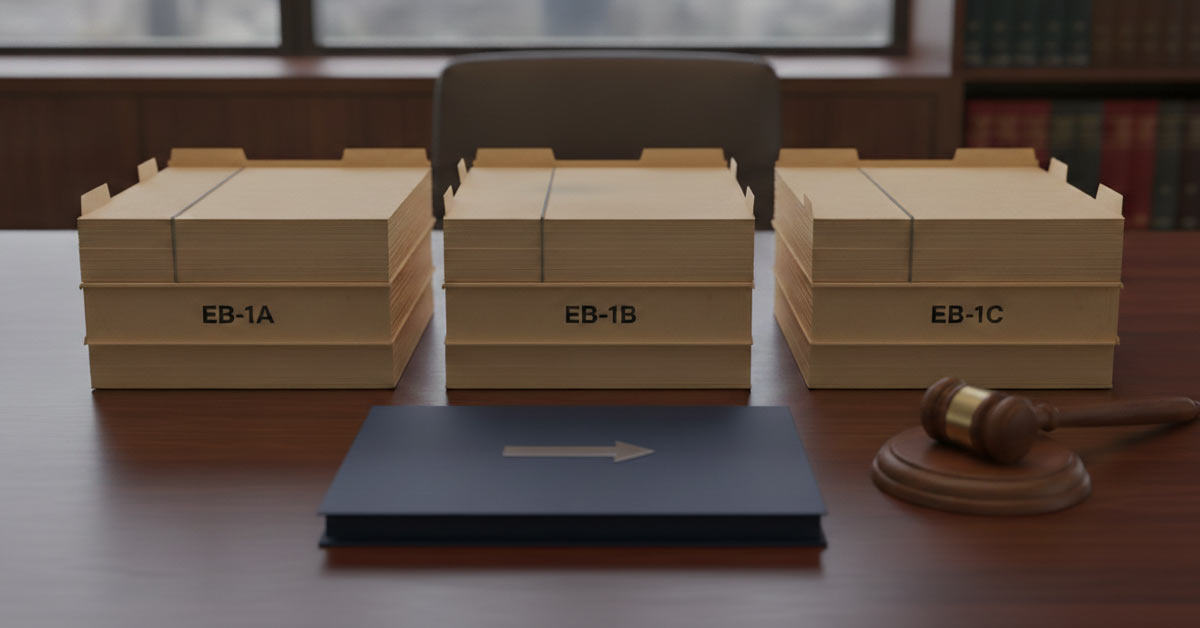
Separating the three branches of the first preference correctly prevents needless denials. The EB-1B is the employer-sponsored academic route; it wants a permanent position and international recognition. The EB-1A needs no employer or job offer and allows self-petition; but its bar is higher, and you are expected to show you are among the small percentage at the very top of your field with three of ten criteria. If you are an academic, both routes are often open; on a strong profile, filing both can be strategic. The EB-1C multinational manager route, in turn, is not academic but managerial and requires a cross-company structure and managerial capacity. Placing your profile in the right branch is the most important decision made at the very start of the file.
EB-1B RFE and Denial Reasons
EB-1B files usually get stuck not on the easy criteria but on points open to interpretation. The most common denial reason is that, even with two criteria met on paper, international recognition is not shown persuasively at the second, holistic stage; if the citation count is low or recognition does not cross borders, the officer is not convinced. The second common reason is that the offered position is not genuinely permanent, for example a short-term fellowship or an adjunct role. The third is weak documentation of the three years of experience or of the private employer's three-researcher requirement. The prevention is the same: build the file around the officer's question, establishing the permanent position, the experience, and the international recognition with concrete, independent evidence.