
The EB-2 NIW (National Interest Waiver) green card path is an advanced category where the applicant's contribution to the U.S. national interest waives the employer sponsorship requirement. As of 2026, the primary challenge of the NIW process lies in determining when the case will conclude; a realistic timeline requires calculating USCIS processing times, Department of State Visa Bulletin Priority Dates, and the I-485 concurrent filing strategy together. Many professionals confuse the approval of the I-140 petition with the actual issuance of the green card, leading to flawed planning. Yellow Law, with its headquarters in Plano, Texas, and partner offices in Chicago (Illinois), Irvine (California), Alpharetta (Georgia), and Fairfield (New Jersey), leverages over 10 years of experience to guide EB-2 NIW clients through timeline planning and filing strategies. The guide details the I-140 process steps, how priority dates function, the advantages of concurrent filing, and waiting period differences based on cross-chargeability.
NIW Process Steps and the Duration of Each Stage
The EB-2 NIW green card path consists of three main stages: preparation and filing of the I-140 petition, USCIS approval, and the final stage with I-485 or consular processing. Each stage has its own timeline, and the sum of the stages is the date the applicant receives the green card.
| Stage | Typical Duration | Description |
|---|---|---|
| I-140 preparation | 2-6 months | Petition letter, evidence set, expert letters collection |
| I-140 standard processing | 9-18 months | USCIS adjudication time (Texas/Nebraska centers) |
| I-140 Premium Processing | 45 calendar days | Through Form I-907 with $2,965 fee (2026) |
| I-485 (when priority date is current) | 8-15 months | AOS application adjudicated by USCIS |
| Consular processing (alternative) | 4-9 months | NVC plus consulate appointment time |
The durations in the table are USCIS official averages; they vary by center and period. Premium Processing was opened to EB-2 NIW petitions in 2022, and the applicant can obtain an I-140 result in 45 calendar days through I-907; we cover its timelines and I-907 fees in our premium processing guide. The period covers approval, an RFE (Request for Evidence) issuance, or denial; it is not a "case is under review" response.
Many applicants interpret I-140 approval as "I obtained the green card"; this is incorrect. I-140 only verifies the applicant's eligibility under the NIW category. To actually obtain the green card, I-485 (when applying from within the U.S.) or consular processing (when applying from abroad) is required. Here is where the priority date comes in.
The general timeline calculation is as follows: preparation (2-6 months) + I-140 processing (45 days PP or 9-18 months standard) + I-485/consular (8-15 months) = a total of 1.5 to 3.5 years. The period applies to countries of birth where the priority date is current. For applicants from retrogressed countries such as India and China, the timeline is much longer.
How the NIW petition is prepared is addressed in our sponsorless green card roadmap, and which Dhanasar criteria it is approved under in our how to get an EB-2 NIW guide. The article clarifies not the preparation of the NIW petition but the timeline logic after approval.
How the Priority Date and Visa Bulletin Work
The priority date represents the date that determines the applicant's place in the green card queue. For EB-2 NIW, the priority date is the date the I-140 petition reaches USCIS (as shown on the USCIS receipt notice). In EB-2 categories that require PERM (employer sponsorship), the priority date is the date the PERM application reaches the Department of Labor; because NIW does not have PERM, the I-140 date is used directly.
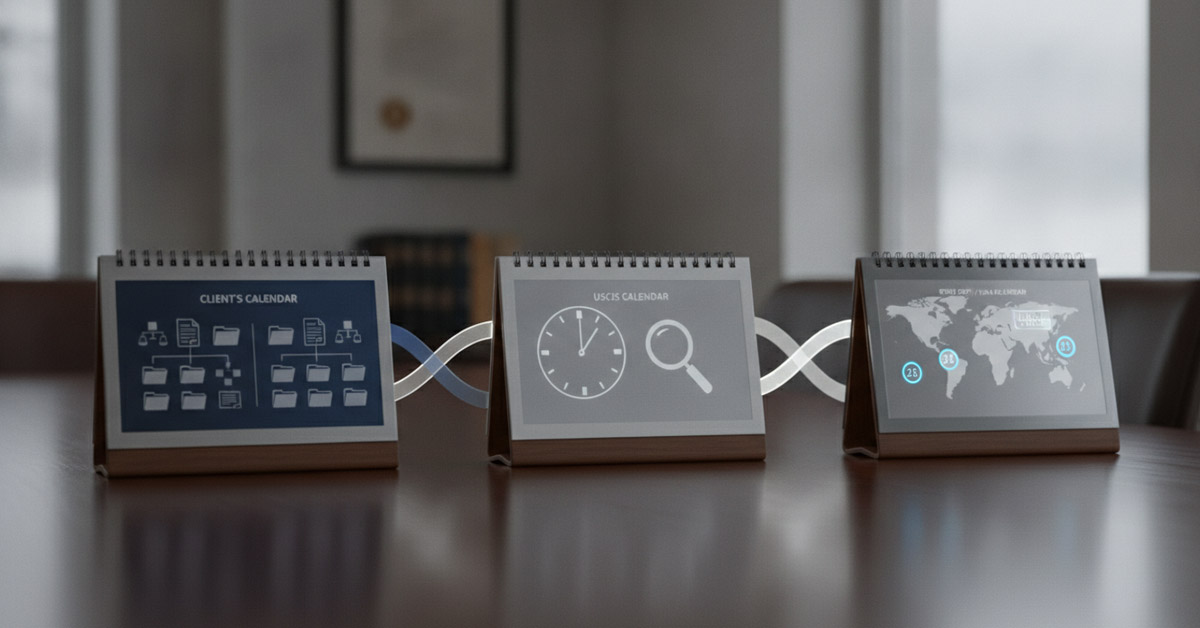
The Department of State publishes a calendar called the Visa Bulletin each month. The Visa Bulletin shows separate priority date cut-off dates in the EB-2 category for the world and by country of birth (India, China, the Philippines, Mexico). If the applicant's priority date is before the cut-off date in the bulletin, the applicant is "current" and can file I-485; otherwise the applicant must wait.
In mid-2026 the EB-2 worldwide priority date (including Turkey) is generally close to current; for Turkish applicants there is no long wait in the NIW priority date queue. India EB-2's priority date is around 2014, meaning an Indian applicant must wait 10 to 12 years in the green card queue. China's priority date is around 2020.
The Visa Bulletin is published in two tables: Final Action Dates (visa can be issued) and Dates for Filing (filing can be made). USCIS announces each month which table to use; the applicant learns which table to use from the USCIS Visa Bulletin page. When the "Dates for Filing" table is more generous, the applicant gains the right to file I-485 early.
The detailed reading of the Visa Bulletin and how family-based visa queues are compared with EB categories is addressed systematically in our visa bulletin reading guide.
Concurrent Filing Strategy and Its Advantages
When the EB-2 priority date of most countries, including Turkey, is current, the applicant can file I-140 and I-485 at the same time; this practice is called "concurrent filing." Concurrent filing creates time economy for the applicant and grants the right to file I-485 without waiting for I-140 approval.
The strategy brings two gains: I-485 is processed simultaneously with I-140, and the total timeline drops to 1.5 to 2 years. At the same time, the applicant gains the right to file I-765 and I-131 for work authorization (EAD) and a travel permit (Advance Parole), which lets them work and travel during the wait.
- EAD (Form I-765): Grants work authorization to the I-485 pending applicant without being tied to a sponsor employer. EAD is valid for five years and is renewed until I-485 is resolved. The freedom is decisive for the NIW applicant because the career path is no longer in the employer's grip.
- Advance Parole (Form I-131): Grants international travel rights to the I-485 pending applicant. Without AP, if the applicant leaves the U.S., the I-485 petition is automatically considered abandoned. AP is valid for one to two years and is renewed as needed.
- Child protection (CSPA): A child of the applicant under 21 is protected from "aging out" when I-485 is filed at the moment of concurrent filing (Child Status Protection Act).
Concurrent filing has no clear disadvantage, yet two points should be considered. If I-140 is denied, I-485 is automatically denied, and the applicant loses the I-485 application fee ($1,440 in 2026). During the I-485 process the applicant's status is "AOS pending," so movements such as a job change, address, and marital status must be reported to USCIS.
Whether to file concurrent or to file I-485 after I-140 approval depends on the strength of the NIW petition. For a weak NIW petition concurrent filing is risky; for a strong NIW petition it is almost always advantageous. To assess whether your NIW petition is strong enough for concurrent filing, you can work with our EB-2 NIW lawyer team.
How Country of Birth Determines Your Wait
EB-2 NIW timing differs dramatically by the applicant's country of birth. For Turkey-born applicants the timeline is generally 1.5 to 3 years; for India-born applicants the same petition can turn into a process of 10 to 15 years.
The reason for this difference is the Visa Bulletin's "per-country cap" rule. U.S. immigration law sets a limit of allocating no more than 7 percent of the total annual green card quota to each country of birth. When applicants from high-application countries hit this 7-percent limit, the priority date retrogresses.
In the EB-2 category in mid-2026, the most retrogressed countries are India and China. Countries such as Turkey, Brazil, Pakistan, Egypt, and the Philippines are generally current. That makes NIW one of the fastest green card paths for Turkish applicants, concurrent filing included.
The country-of-birth rule sometimes produces surprising outcomes. An applicant born in India but a citizen of Turkey or another country is subject to the India priority date; citizenship is not decisive here. By contrast, "cross chargeability" can be requested from the spouse's country: an applicant born in India but married to a Turkey-born spouse can benefit from the spouse's country-of-birth priority date.
Cross chargeability is indicated on Form I-485 at the time of filing and documented with the spouse's Turkish birth certificate. The strategy is a method for India-born and China-born professionals to bypass years of waiting; it can be used only if the marriage is genuine and valid at the moment of concurrent filing.
How NIW compares with alternative green card paths and which profiles it fits is systematically presented in our green card decision matrix. The official USCIS NIW page is published at the USCIS EB-2 page, and the Visa Bulletin at travel.state.gov.
Let's Plan Your EB-2 NIW Timeline Together
The right EB-2 NIW timeline starts with a strategy built around the strength of your petition and your country of birth. Yellow Law Group, headquartered in Plano (Texas) with partner offices in Chicago (Illinois), Irvine (California), Alpharetta (Georgia), and Fairfield (New Jersey), guides EB-2 NIW clients on the concurrent filing decision, priority date planning, and cross chargeability eligibility with more than 10 years of experience. To clarify your NIW eligibility and a realistic timeline, work with our Texas Bar licensed attorneys and schedule a free 30-minute consultation through our contact page.