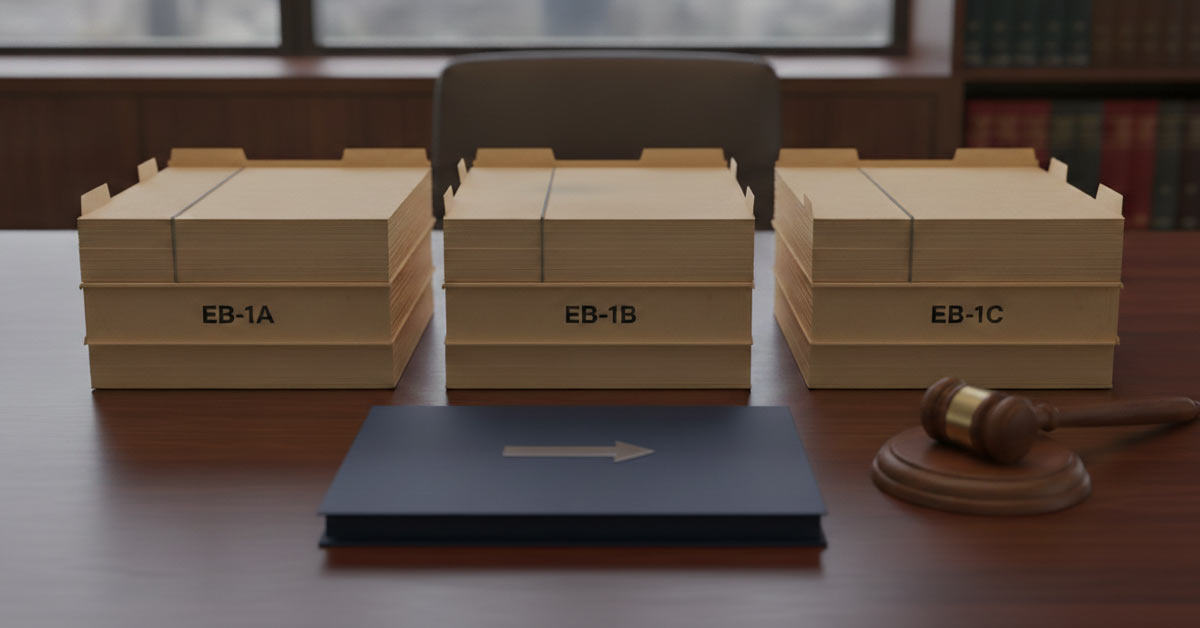

EB-1 is not a single category but three separate routes, and which one you enter is determined less by the size of your achievement than by who you are: an expert who rose on their own, an academic with international recognition, or a manager at a multinational company. What the three share is that they skip the labor certification (PERM) stage; where they diverge is who files the petition and whether it ties you to an employer. Yellow Law Group guides Turkish professionals in choosing the right EB-1 route from its Plano (Texas) headquarters and its Chicago (Illinois), Irvine (California), Alpharetta (Georgia), and Fairfield (New Jersey) partner offices, with over 10 years of collective attorney experience. This guide puts the three side by side and explains which suits whom.
The Three Routes at a Glance
| Category | Who it is for | Who files the petition |
|---|---|---|
| EB-1A | An individual with extraordinary ability at the top of their field | You (no employer needed) |
| EB-1B | An outstanding professor or researcher with international recognition | Your US employer |
| EB-1C | A manager or executive at a multinational company | Your US company |
None of the three enters the PERM process, which saves months. All three run on an I-140 petition, and the official framework is published on the USCIS first preference EB-1 page. We summarized the general framework of the categories in our EB-1 green card service.
The Question That Decides It: Who Files the Petition
The most practical difference among the three routes looks not at you but at who owns the file. In EB-1A you file the petition yourself; no job offer and no sponsor are needed, and the file is built in your name on your achievement. In EB-1B and EB-1C the US employer files, and the file rests on your tie to that employer.
The consequence is this: in EB-1A, leaving your job or changing employers does not affect your file, because there is no employer you are bound to. In EB-1B and EB-1C, if you leave the sponsoring company the petition loses its basis. When choosing, your expected career mobility carries as much weight as meeting the criteria.
Who EB-1A Is For
EB-1A is for individuals with extraordinary ability and sustained national or international acclaim in the sciences, arts, education, business, or athletics. Qualification is established either through a one-time major award such as an Olympic medal, or by meeting at least three of the ten set criteria; the officer then makes a second assessment looking at the file as a whole.
If the route fits you it carries two strong advantages: you are not tied to an employer, and you set your own timing. In exchange, the bar is the highest of the three. We covered in detail how the criteria are met and how the second-stage assessment works in our EB-1A ten criteria and Kazarian guide; for representation you can review our EB-1A attorney service.
Who EB-1B Is For
EB-1B is for outstanding professors and researchers recognized internationally in their academic field. Three conditions are required together: international recognition in your field, at least three years of teaching or research experience, and a permanent job offer from a US employer. In college and university positions, permanence means a tenured or tenure-track role. On the evidence side, at least two of six criteria are met.
The permanent position requirement is the most overlooked part of the category: fixed-term postdoctoral positions and project-based contracts often fail to meet it. We took up how the permanence test is built in our EB-1B guide; for legal support our EB-1B attorney service steps in.
Who EB-1C Is For
EB-1C is for those in managerial or executive roles at a multinational company, and it is the only category that looks at corporate structure instead of personal achievement criteria. Three elements are required: having worked in a managerial or executive capacity at the foreign company for at least one year of the three years preceding the petition, a qualifying relationship between the US and foreign entities (parent, subsidiary, affiliate, or branch), and the US company having been doing business for at least one year.
The category is the natural continuation for managers who came to the US on an L-1A visa. We explained how managerial capacity is documented and the most common requests for evidence in our EB-1C guide; for representation you can review our EB-1C attorney service.
Decision Matrix: Seven Points of Comparison
| Criterion | EB-1A | EB-1B | EB-1C |
|---|---|---|---|
| Sponsor | Not needed | US employer required | US company required |
| Job offer | Not needed | Permanent position | Managerial/executive role |
| Evidence axis | Individual achievement, 3 of 10 criteria | Academic recognition, 2 of 6 criteria | Corporate structure and role definition |
| PERM | None | None | None |
| If you leave the job | File unaffected | Petition loses its basis | Petition loses its basis |
| Premium processing | 15 business days | 15 business days | 45 business days |
| Typical profile | Entrepreneur, artist, athlete, senior specialist | Faculty member, senior researcher | General manager, regional director, founding partner |
Three Situations That Get Confused
- Academic: EB-1A or EB-1B? If you hold a permanent position at a university, EB-1B is generally more reachable, because its bar is lower and two of six criteria suffice. If your publication and citation profile shows the top of your field, EB-1A frees you from depending on an employer. Planning both files together is also possible.
- Manager: EB-1C or EB-1A? If you have a year of managerial history at the foreign company and there is a US entity with a qualifying relationship, EB-1C is a far more direct route; you do not need to prove personal acclaim. If the corporate structure requirement does not hold, converting your business achievement into EB-1A criteria comes onto the table.
- EB-1C at your own company: Being a founding partner does not close the category, but the US entity has to have been genuinely doing business for at least a year and your role has to be managerial in content. In one-person structures the role definition often comes out operational rather than executive.
Timing, Fees, and Queue Status
The base filing fee for the I-140 petition is 715 dollars. Premium processing is optional and has been 2,965 dollars since March 1, 2026. The time guarantee varies by category: 15 business days for EB-1A and EB-1B, 45 business days for EB-1C. What the guarantee covers is not approval but that USCIS takes an action within that window; the result may be an approval, a denial, a request for evidence, or a notice of intent to deny. You can review the request procedure on the USCIS premium processing page.
On the queue side the picture is favorable for Turkish applicants. In the July 2026 visa bulletin the EB-1 category is current for the general group that includes Turkey, meaning there is no priority date wait. In the same period, applicants born in India and China are waiting on dates that moved backward. Because the bulletin is renewed monthly, the situation at the time of filing needs to be confirmed from the Department of State visa bulletin.
Filing in More Than One Category at Once
More than one I-140 petition can be filed for the same person, and the categories do not block one another. The combination seen most often in practice is running an employer's EB-1B petition in parallel with the person's own EB-1A petition among academics. A second file means additional fees and additional preparation, but if one is denied the other stays standing.
The same logic extends beyond EB-1. For applicants without an employer, EB-1A and the EB-2 national interest waiver are often assessed together; because the evidence structure of the two routes differs, a profile can come out weak in one and strong in the other. We compared all the sponsor-free options in our self-petition green card roadmap.
Which Routes Stay Open if EB-1 Does Not Fit
If none of the three categories fits your profile, the road does not close. The EB-2 national interest waiver allows a petition without an employer and without PERM, and its bar is more reachable than EB-1A's; you can find the details in our EB-2 NIW attorney service. If you are not ready for a green card, the O-1 visa builds a temporary step, and because it allows dual intent you can file an I-140 without putting your status at risk; our O-1 attorney service manages that transition. You can find a comparison of all permanent residence routes in our green card roadmap.
Choose the Right EB-1 Route With Yellow Law Group
Entering the wrong category costs time and fees more than it costs the strength of the file. Comparing your profile against the standards of the three categories often shows from the outset which one is realistic. Yellow Law Group supports Turkish professionals on EB-1 files from its Plano (Texas) headquarters and its Chicago (Illinois), Irvine (California), Alpharetta (Georgia), and Fairfield (New Jersey) partner offices. The handshake in our logo symbolizes the foundation of the partnership built with the client; our attorney team's 10 years of collective practice carry the same approach. To assess which category your profile fits, you can schedule a 30-minute free initial consultation with our Texas Bar licensed attorneys through our contact page.