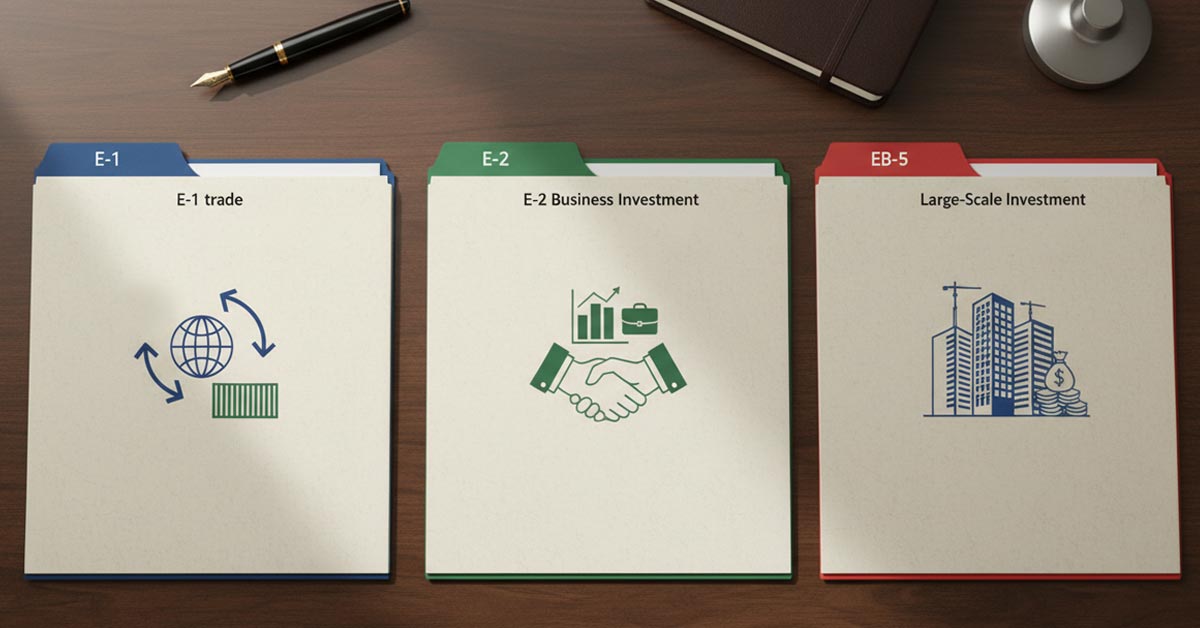
As of 2026, foreign founders entering the United States through investment or trade face three primary federal options: E-1 Treaty Trader (9 FAM 402.9-6 substantial trade rule), E-2 Treaty Investor (8 CFR §214.2(e) substantial investment rule), and EB-5 Investor (post-RIA 2022 threshold of USD 800,000 to 1,050,000). The three visas offer different paths in terms of capital, duration, and long-term permanent status. Yellow Law Group, headquartered in Plano (Texas) with offices in Chicago, California (Irvine), Atlanta, and a New Jersey partner, guides international investors through strategic selection with an attorney team possessing over 10 years of collective experience. The guide compares the three visas side by side; it details each visa's criteria and shows which investor profile fits which option.
Decision Matrix: E-1, E-2, and EB-5 Side by Side (2026)
The table below summarizes the three visas at a glance. Subsequent sections walk through each visa in detail.
| Criterion | E-1 Treaty Trader | E-2 Treaty Investor | EB-5 Investor |
|---|---|---|---|
| Type | Nonimmigrant (temporary) | Nonimmigrant (temporary) | Immigrant (Green Card) |
| Minimum investment | No fixed investment; 50%+ trade between U.S. and treaty country | ~USD 100,000+ in practice (substantial) | USD 800,000 (TEA) / USD 1,050,000 (non-TEA) |
| Treaty country | 50+ countries (Turkey included) | 80+ countries (Turkey included) | No treaty required |
| Duration | 2 years, unlimited renewals | 5 years, unlimited renewals | Conditional 2 years → permanent 10-year LPR |
| Active operation | Conduct trade activity | Actively manage investment | Direct: active; Regional Center: passive |
| Path to permanence | Indirect (EB-1C, NIW) | Indirect (EB-1C, NIW, EB-5) | Direct Green Card |
| Spouse work auth | E-1S automatic (2022) | E-2S automatic (2022) | EAD |
| Federal statute | INA §101(a)(15)(E)(i) | INA §101(a)(15)(E)(ii) | INA §203(b)(5) + RIA 2022 |
The decision depends on three questions: capital volume and structure (E-2 or EB-5?), trade intensity (does E-1 fit?), and permanent status priority (Green Card first or flexible nonimmigrant status?). Investors looking at non-investment Green Card routes in a comparative map can consult our 12 Proven Paths to a U.S. Green Card guide; this article focuses on investor-driven selection.
E-1 Treaty Trader: The 50% U.S. Trade Rule and the Turkish Merchant's Path
E-1 rests on trade activity; the investment amount is not central; the trade volume and continuity are the primary measures. Under 9 FAM 402.9-6, "substantial trade" requires three elements: (1) the trade must be international, between the United States and the treaty country (Turkey included), (2) more than 50% of the trade volume must flow between the U.S. and the treaty country, (3) the trade must be substantial, meaning a continuous and regular flow (a one-off large transaction does not suffice).
Activities qualifying as "trade" under E-1 include goods import/export, services trade (consulting, engineering, IT), international banking, insurance, transport, and tourism. Turkey-to-U.S. textile, machinery, automotive parts exports or U.S.-to-Turkey technology service sales are common E-1 scenarios. The consulate requests the past 12 months of invoice records; demonstrating an ongoing commercial relationship is mandatory.
The application runs through two forms: DS-160 (general nonimmigrant application) and DS-156E (E-visa-specific 4-page form). Turkish passport holders interview at the U.S. consulate in Ankara or Istanbul; as of 2026, the wait time runs roughly 4 to 9 months. Detailed E-1 application mechanics, treaty country list, and sector eligibility assessment fall under our E-1 Treaty Trader visa service where the sponsor and company structure are reviewed together. The USCIS E-2 Treaty Investors official page is the authoritative source.
E-2 Treaty Investor: Investment Amount and the "Marginality" Rule
E-2 covers an investor who establishes or acquires an active enterprise in the United States. Under 8 CFR §214.2(e), four core criteria apply: (1) treaty country national status (Turkey included), (2) a substantial investment, (3) the enterprise must be a bona fide commercial venture, (4) the investment must not be marginal, meaning it must not exist solely to provide the investor a living but must produce economic impact.
For "substantial," the statute sets no fixed minimum; the practical standard is the proportionality test, which varies by enterprise type and the required investment amount. While 100,000-150,000 USD may be substantial for a restaurant, anything below 500,000 USD for a hotel or manufacturing facility is unlikely to clear the bar. The average Turkish E-2 file falls in the 100,000-300,000 USD range.
The "marginality" test is USCIS's most frequent denial ground. The enterprise must not merely sustain the investor's family; it must contribute to the local economy, employ at least one to two U.S. citizens or LPRs, or demonstrate growth potential in the business plan. Source of Funds documents (bank statements, SWIFT transfers, income tax returns, real-estate sale evidence) prove to USCIS that the investment originates from a lawful source.
The step-by-step mechanics of the E-2 application, 2026 USCIS fees, and consulate appointment process are detailed in our How to Apply for a U.S. E-2 Visa guide with current 2026 figures. The legal framework of the marginality test and the technical expansion of the "Mere Livelihood" standard are evaluated on a case-by-case basis through our E-2 investor visa service.
EB-5 Investor: $800K / $1.05M Direct Investment vs Regional Center
Among the three visas, EB-5 is the only direct route to a Green Card. The program, governed by INA §203(b)(5), was restructured in 2022 through the Reform and Integrity Act (RIA); the minimum investment threshold was set in two tiers:
- USD 800,000 - Targeted Employment Area (TEA): rural areas, high-unemployment areas, and infrastructure projects.
- USD 1,050,000 - Standard areas outside TEA.
Investment moves through two channels. Direct Investment: the investor establishes or acquires a U.S. company, employs 10 full-time U.S. citizen or LPR workers, and actively manages the business. Regional Center: the investor takes a passive stake in a USCIS-approved regional center's pooled investment fund; job creation is counted through indirect and induced employment methods.
The most significant RIA 2022 innovation is the concurrent filing right: an investor in a lawful nonimmigrant status in the U.S. can file I-526E together with I-485 (AOS), I-765 (EAD), and I-131 (Advance Parole). The investor maintains lawful status in the U.S. and obtains work authorization while waiting for EB-5 approval.
EB-5's most frequent denial ground is improperly structured at-risk capital; the investment must carry no repayment guarantee, and the investor must genuinely bear the risk of loss. The seven specific USCIS denial scenarios are detailed in our EB-5 At-Risk Capital Standard article. Direct vs Regional Center selection and I-526E preparation are managed through our EB-5 investor visa service, evaluating the project against the investor profile.
Status Renewal and Long-Term Investment Strategy
The three visas differ in renewal mechanics; an investor planning long-term should weigh these at incorporation.
- E-1 renewal: 2-year increments with unlimited renewal. Each renewal requires proof that the 50%+ U.S.-treaty country trade rule is maintained; the ongoing commercial relationship is shown via invoice and contract records.
- E-2 renewal: 5-year increments with unlimited renewal. The investor demonstrates that the investment is non-marginal, the enterprise remains active, and there has been no material change in the corporate structure. New partner admission, sale, or transfer triggers a renewed evaluation.
- EB-5 conditions removal: Form I-829 must be filed 90 days before the conditional Green Card's 2-year expiration. If the investment remains at-risk and 10 jobs were created and sustained, the LPR receives permanent 10-year status.
Preservation of investor status during company sale or transfer, long-term spouse and child status (E-1S/E-2S automatic work authorization post-2022, age-out scenarios for children turning 21), and pre-renewal documentation standards will be detailed in upcoming visa-specific cluster articles. For a strategic renewal plan and the cluster publication schedule, request a consultation call.
Localized Context for International Investors: Consulates, Sectors, Yellow Law Multi-State
Turkish passport holders apply at the U.S. Consulate in Ankara or Istanbul. As of 2026, the post-DS-160 consulate interview lead time runs roughly 4 to 9 months; once a slot opens, E-visa interviews are placed in a priority queue. Filing DS-156E completely and having source-of-funds documents translated and apostilled where required lowers the denial risk before the interview.
Sectors with high E-1 and E-2 success rates for Turkish investors:
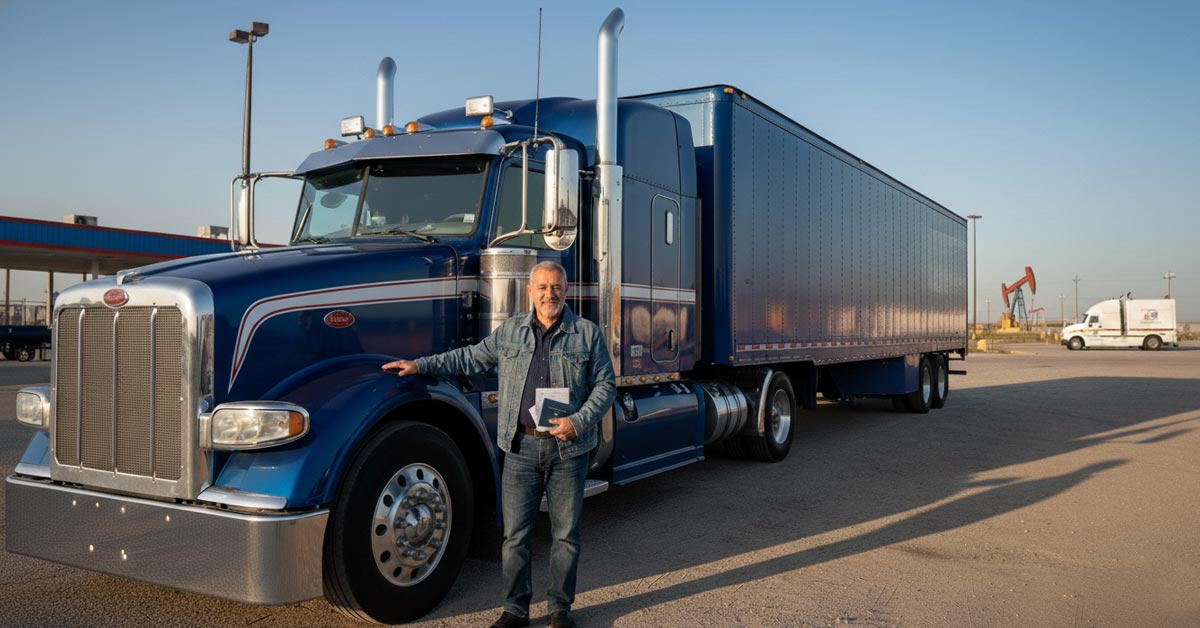
- Logistics and trucking: Turkish fleet owners pursuing U.S. trucking ventures find sector practice mapped in our E-2 Visa and Trucking Investments guide.
- Textile and apparel exports: Turkey's global competitive position favors the E-1 substantial trade test.
- Restaurants and food service (F&B): In Texas, California, and New Jersey, Turkish founders often clear the marginality test with 1-2 employees plus a scalable business plan.
- Technology and consulting services: Silicon Valley (Irvine), Atlanta tech hub, and Chicago finance-tech ecosystems suit E-1 services trade or E-2 investment.
Yellow Law Group's five-office structure places legal support nearest the region where the investor builds: Plano (Texas) headquarters covers the DFW metroplex; Chicago (Illinois) reaches Midwest investors, Irvine (California) the Silicon Valley and Los Angeles markets, Alpharetta (Georgia) the Southeast logistics ecosystem, and Fairfield (New Jersey) the NY metro and financial services gateway.
The handshake in our logo reflects the partnership philosophy with the client; our attorney team's 10 years of collective practice carries the same foundation. Our Texas Bar licensed attorneys stand among a narrow group fluent in the intersection of U.S. federal law and foreign commercial codes. The relationship that begins at our firm sustains long-term investor journeys with continuous support.