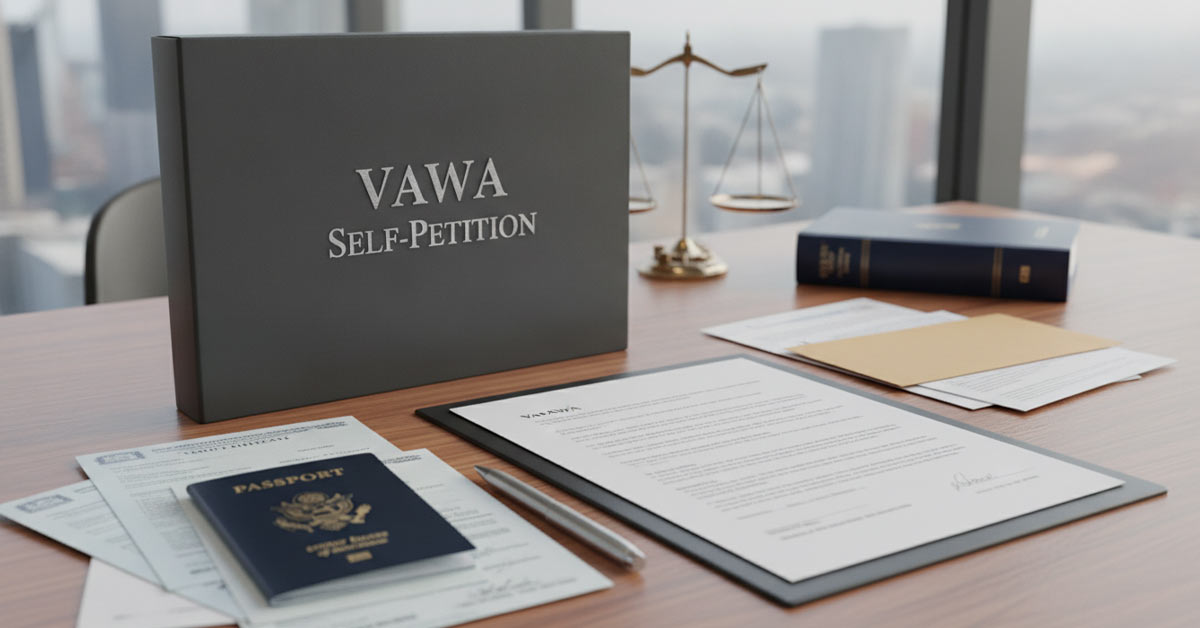

VAWA gives people who have experienced domestic violence or abuse the right to apply for a green card on their own, without needing the abuser's consent. Although it is named the "Violence Against Women Act," the protection is gender-neutral: women, men, and people of any gender can file equally. This guide covers how the VAWA self-petition (Form I-360) is built around the officer's question: who qualifies, what is required, how abuse is documented, how the petition stays confidential, and how work authorization and the green card follow approval. We summarize the attorney support on our VAWA petitions attorney service. It is general information, not legal advice.
If you are in immediate danger, call 911. For free and confidential support, you can reach the National Domestic Violence Hotline at 1-800-799-7233. For your safety, we suggest reading this page from a safe device and checking your browsing history.
What Is VAWA and Who Can Self-Petition?
The VAWA self-petition, grounded in Section 204(a)(1) of the immigration law, lets an abused relative apply for permanent residence without depending on the abuser. Three groups can file: the abused spouse of a US citizen or lawful permanent resident (LPR), the abused child of the same, and a parent abused by a US-citizen son or daughter. The parent route has a limit: it is open only where the abuser is a US citizen aged 21 or over; the parent of an LPR child cannot file this way. The protection does not distinguish by gender and covers same-sex marriages; male victims hold exactly the same right. Even in a marriage that has no legal validity solely because of the abuser's bigamy, an "intended spouse" who married in good faith can file. You can review the official framework on the USCIS battered spouse, children and parents page.
VAWA, U, and T Visas: Which Route Fits You?
The one thing that separates the three routes is the type of your relationship with the abuser. VAWA is for situations where the abuser is a US citizen or LPR bound to you by family: a spouse, parent, or child. If you have no family tie to the abuser but you are the victim of a crime and helped law enforcement, the route is the U visa. If what you experienced is a form of human trafficking such as forced labor, debt bondage, or commercial sexual exploitation, the route is the T visa. VAWA's distinguishing strength is that it makes the green card path independent of the abuser's consent; we cover the other two routes in detail on their pages.
Eligibility: Relationship, Abuse, Shared Residence, Good Moral Character
The petition requires four core elements together. First, you must have a qualifying family relationship with the abuser, and the abuser must be a US citizen or LPR; for spouse petitions, the marriage must have been entered into in good faith (bona fide), not to evade immigration law. Second, you must have resided with the abuser at some point; you do not need to still live together at the time of filing, and you can petition after separating. Third, you must have been subjected to battery or extreme cruelty by the abuser during the relationship. Fourth, you are expected to be a person of good moral character; for petitioners over 14 this is generally assessed over the past three years. An act done under coercion connected to the abuse does not automatically destroy good moral character where there is no conviction and extenuating circumstances exist.
Documenting Abuse: The "Any Credible Evidence" Standard
Battery or extreme cruelty is not only physical assault. The law treats as violence a pattern that includes psychological and sexual abuse, economic pressure, threats and degradation, isolation, and threats made through immigration status; acts that may not look violent on their own but are part of a controlling pattern also fall within it. VAWA applies an "any credible evidence" standard, so no single document is mandatory. Your own detailed declaration, witness affidavits, protection orders, and records from medical staff, police, courts, schools, clergy, or social services, along with photographs of visible injuries, can all be used. Even without a police report or medical record, a credible personal declaration can carry significant weight. Form I-360 itself is free and is filed without the abuser's knowledge or signature.
Confidentiality: The Abuser Is Not Notified of Your Petition
VAWA's strongest protection is confidentiality. Under 8 U.S.C. 1367, USCIS cannot disclose your petition to the abuser or the abuser's family and cannot make a removal decision against you based solely on information the abuser provided; a violation carries a monetary penalty. The protection directly answers the fear of "my spouse will withdraw my petition" or "my spouse will report me," because the green card path no longer depends on the abuser's sponsorship. The protection is strong but not unlimited; a policy that took effect at the end of 2025 narrowed how it is applied in some situations. Managing the confidentiality of your file correctly from the start is one of the most delicate parts of the process.
After Approval: Work Authorization and the Green Card
An approved I-360 opens two doors. The first is work authorization: the principal self-petitioner can apply for an employment authorization document (EAD) under category (c)(31) after the petition is approved, and this authorization flows directly from the approved petition, not from the abuser or from deferred action. USCIS may also grant approved self-petitioners deferred action; in 2026 deferred action has become a case-by-case discretionary decision, but the principal's work authorization is independent of it. The second door is the green card, and it varies with the abuser's status. If the abuser is a US citizen, you are an "immediate relative": a visa number is always available, there is no wait, and you can file the I-360 and I-485 at the same time. If the abuser is an LPR, the petition falls in the F2A preference category; that category is numerically limited and is not fully current on the July 2026 Visa Bulletin, so even if you can file, approval waits until your priority date is current. We assess the current picture based on your file.
The Two-Year Rule: Divorce, Loss of Status, and Death
A change in the marriage or in the abuser's situation does not always end your right. If you are divorced, you keep your right if the divorce is connected to the abuse and you file within two years of the divorce becoming final. If your abusive US-citizen spouse has died, you can file within two years of the death. If the abuser lost citizenship or an LPR status because of a domestic-violence incident, you can file within two years of that loss of status. An important safeguard: once you have properly filed your petition, the abuser's later divorce, loss of status, or death does not harm your pending or approved case. Because these windows are narrow, timing is one of the parts of the file that demands the most care.
How Long It Takes and Your Safety During the Process
All VAWA I-360 petitions are adjudicated by the VAWA unit at the Vermont Service Center, and there is no premium processing. Processing times vary and have grown longer recently; average times run over a year, and the total process through the green card stage can reach several years. Rather than give an exact date, we check the picture together using USCIS's current processing-time tool at the time of filing. Your safety is a priority throughout: we plan for correspondence to reach a safe address, use safe-address procedures where needed, and point you to support resources for emergencies. This text provides legal information; for crisis counseling, the relevant hotlines and organizations are there for you.
Common Mistakes and Denial Reasons
VAWA files usually get stuck not on the easy points but where the evidence is built weakly. The most common problem is treating extreme cruelty as only physical violence and leaving psychological and economic abuse undocumented; a consistent personal declaration that describes the pattern is often decisive. The second common reason is that the good-faith marriage or family relationship is not proven well enough. The third is missing the two-year windows or documenting the abuser's status incompletely. Because the end-of-2025 policy change made the shared-residence and good-moral-character review stricter, building the file to that view matters. The prevention is the same: establish each element with concrete, consistent, and independent evidence.
Build Your VAWA File With Yellow Law Group
In VAWA, what decides the outcome is not the weight of what you experienced, but how what you experienced is translated into the evidentiary language the officer looks for. Yellow Law Group, from its headquarters in Plano (Texas) and offices in Chicago (Illinois), Irvine (California), Alpharetta (Georgia), and Fairfield (New Jersey), assesses your eligibility, prepares the I-360 petition and the evidence file, manages confidentiality from end to end, and handles the green card stage when needed. We move the process without judgment, in Turkish and English, with your safety in mind. You can review our attorneys on our team page and schedule a free initial consultation, in confidence, through our contact page.