
For most Turkish entrepreneurs who have built, or plan to build, a business in the US on an E-2 investor visa, the question is always the same: "Will this visa one day take me to a green card?" The short answer is uncomfortable: no, not on its own. The E-2 renews indefinitely, yet it never converts into permanent residence; at each renewal you prove again that your business is real, active, and not marginal, and you keep the status only as long as the business survives. The good news: while you stay on E-2, you can run a green card process in parallel. The guide's subject is exactly that, how to turn your E-2 into a permanent green card through EB-5, EB-1C, or EB-2 NIW. We cover what the E-2 is and how to get it in our guide to getting the E-2 visa; the article here picks up exactly where that one stops, at the question of permanence. It is general information, not legal advice.
The E-2 Is Temporary: Why Indefinite Renewal Is Not Permanent Residence
The most misunderstood thing about the E-2 is this: renewing it indefinitely does not make it permanent. To USCIS, the E-2 is a nonimmigrant status; each entry grants a two-year stay and it can be extended without limit, yet no extension brings you automatically closer to a green card. On top of that, an E-2 holder must keep the intent to depart the US when the status ends. In theory you could live thirty years on E-2 and still never gain permanent residence.
The distinction has three hard consequences in practice: if your business fails, the status ends with it; children who turn 21 stop being E-2 dependents; and no year on E-2 leads you to citizenship. Permanence comes only through a separate immigrant category. You can review the official definition of E-2 status on the USCIS E-2 page.
The Difference Between E-2 and a Green Card: Rights, Family, and the Age-21 Risk
The gap between the E-2 (a temporary status) and a green card (permanent residence, LPR) is about more than time. A green card holder lives and works in the US indefinitely, can apply for citizenship after five years, and keeps the status even after closing the business. The E-2 is tied entirely to the business.
The most overlooked risk is the children. An E-2 dependent child loses status at 21; at that point they must find their own status or leave the country. For a child who finished high school in the US and started college, the clock has already begun, and the family loses the luxury of postponing its green card plan. Most advisers, for exactly that reason, suggest starting the permanent process while the children are young.
The Parallel Strategy: Filing an Immigrant Petition While Staying on E-2
Here is the heart of it: you do not have to give up the E-2 to move toward a green card. The right approach is to run an immigrant petition in parallel while keeping your E-2 status. A delicate balance comes into play here. The E-2 is not a "dual intent" visa, so you are expected to keep your intent to depart. Even so, the existence of an immigrant petition (such as an I-140 or I-526E) does not by itself break your E-2; the regulation expressly says E classification may not be denied solely on the basis of an approved labor certification or a filed immigrant petition.
The tension shows up at two points. First, when you travel abroad and renew your E-2 visa, or at the border, your intent to depart is tested again. Second, filing for adjustment of status from inside the US (Form I-485) openly manifests immigrant intent; it can block extending your E-2 and makes travel risky without advance parole. On top of that, a USCIS policy that took effect in 2026 made adjustment of status more discretionary and pushed consular processing forward. In the end, the timing, and the choice between adjusting status inside the US or consular processing abroad, is the heart of the case.
From E-2 to EB-1C: Using Your E-2 Company in a Multinational-Manager Transfer
EB-1C is a strong green card category for managers and executives of multinational companies that needs no labor certification (PERM). On paper it looks ideal for an E-2 investor; in reality, most solo E-2 investors do not fit it. The reason: EB-1C needs a qualifying relationship (parent, subsidiary, branch, or affiliate) between your US company and a company abroad, and it asks that you worked as a manager at that foreign company for at least one of the prior three years. An investor who built an independent US company from scratch and closed their company in Turkey has no foreign entity to anchor the petition.
The category becomes reachable only with deliberate structuring: if you keep your company in Turkey as the parent or an affiliate of your US company and document your managerial role there, and the US company has operated for at least a year, the door opens. In practice many investors move first to an L-1A manager visa, then to EB-1C. We assess whether the structure fits you in our EB-1C green card service.
From E-2 to EB-5: Topping the Capital Up to $800,000
The second route is EB-5, which turns investment into a green card. The "substantial investment" amount in E-2 has no fixed floor and usually sits below the EB-5 threshold, so the task is not simply "adding a bit more money." EB-5 on its own asks for four things:
- Amount: $800,000 in a Targeted Employment Area (rural or high-unemployment), or $1,050,000 in a standard area. The amounts are indexed to inflation and take their first increase on January 1, 2027; anyone deciding between 2026 and 2027 should factor it in.
- New commercial enterprise: The business must have been established after November 29, 1990, or be bought and restructured, or be expanded through the investment to grow its net worth or headcount by 40%.
- Capital: The full amount must be your own lawfully sourced money, genuinely placed at risk, and you must actively run the business.
- Jobs: Ten NEW full-time (35+ hours/week) jobs tied to the investment must be created; existing E-2 employees do not automatically count, and you and your family never count.
The big advantage for Turkish investors is timing: Turkey is current in every EB-5 category (May 2026 Visa Bulletin), so an E-2 investor in the US can file I-526E and I-485 together and get a work permit and travel document while the petition is pending. Where China and India wait for years, a Turkish applicant does not. We work through whether to run the process through your own business or a regional-center project in our EB-5 investor visa service, and you can confirm the current amounts and requirements on the USCIS EB-5 page.
From E-2 to EB-2 NIW: A Self-Petition With No Sponsor
For a solo E-2 entrepreneur, the most realistic employment-based route is often the EB-2 NIW (National Interest Waiver). The reason is simple: NIW is one of the few categories where you can self-petition with no employer, no job offer, and no PERM certification. Yet NIW is not a "green card for investing money." You first have to qualify for EB-2: either as an advanced-degree professional (a graduate degree) or as a person of exceptional ability in business. Then you have to pass the three-prong Dhanasar test: that your proposed endeavor has substantial merit and national importance, that you are well positioned to advance it, and that waiving the job-offer requirement benefits the US.
An E-2 investor with advanced education or expertise fits the route very well; when you pair the capital with a well-documented, job-creating business plan of national importance, the NIW case grows stronger. For an investor whose only credential is money, with no connected record of success or expertise, it is a hard road. We cover who NIW works for in our EB-2 NIW service, and you can see the official framework of the category on the USCIS EB-2 page.
Which Route Fits You? The EB-1C, EB-5, and EB-2 NIW Decision Matrix
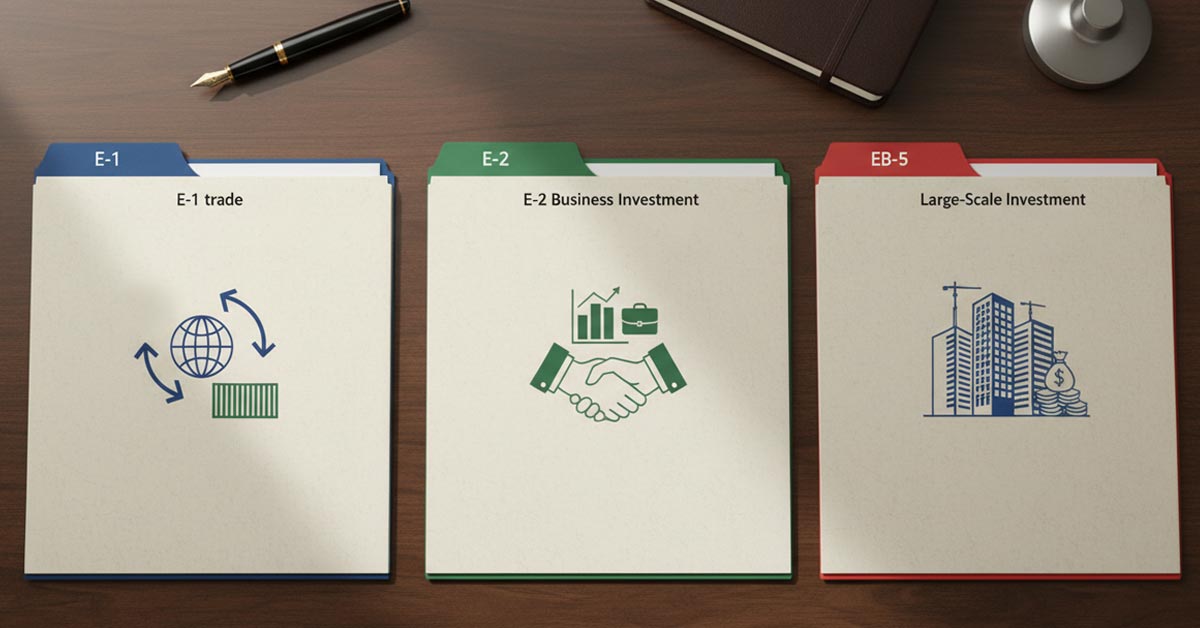
The three routes fit different profiles. The matrix below sums up which one is realistic in which case. (It differs from the entry-stage E-1/E-2/EB-5 investment-visa comparison; the subject here is the move from an existing E-2 to a green card.)
| Category | Who It Fits | Key Requirement | Self-Petition? |
|---|---|---|---|
| EB-1C | An investor with a foreign company where they worked as a manager | Qualifying foreign link + 1 year managing + US company operating 1 year | No (employer files) |
| EB-5 | An investor who can put in $800,000+ and create 10 jobs | Full amount at risk + new commercial enterprise + 10 new jobs | Yes |
| EB-2 NIW | An advanced-degree or expert investor with a nationally important endeavor | EB-2 eligibility + the three Dhanasar prongs | Yes |
A fourth route is worth remembering: marriage to a US citizen. A spouse counts as an "immediate relative," so there is no quota wait, and someone who entered the US lawfully on E-2 can adjust status from within. The basis here rests on family, not investment. To keep the three investment routes distinct from the entry-stage comparison, you can see our E-1/E-2/EB-5 comparison guide; that one covers which visa to get at entry, while the article here covers how to become permanent after E-2.
The Transition Timeline: When Should You Start?
Timing is half of this work. Turkey is currently "current" in the EB-1, EB-2, and EB-5 categories, so once you have an approved petition you do not wait years for a visa number. Applicants born in India and China do not share that privilege. Two caveats remain: the position is a snapshot and the Visa Bulletin changes every month; and because the EB-5 set-aside categories are current even for China and India, the "Turkey advantage" applies only to the general categories. You should always confirm the current position on the Visa Bulletin.
The practical rule: if your children are approaching 21, your business has matured, or you have renewed the E-2 a few times, starting the permanent process in parallel beats postponing it.
From E-2 to Permanent Residence With Yellow Law Group
Renewing the E-2 indefinitely is not a strategy but a postponed decision. The right move is to build the green card route that fits you (EB-1C, EB-5, or EB-2 NIW) from the start, while keeping your status.
Yellow Law Group, from its headquarters in Plano (Texas) and offices in Chicago (Illinois), Irvine (California), Alpharetta (Georgia), and Fairfield (New Jersey), plans the move of E-2 investors to permanent residence as a whole. To assess which route fits your profile, you can review our attorneys on our team page and schedule a free initial consultation through our contact page. You can find our full E-2 service on our E-2 visa page.