
As of 2026, most E-2 investor visa denials by USCIS and consular officers stem not from technical errors on Form I-129 or DS-160, but from selecting a business that fails to meet 8 CFR §214.2(e) standards. The most critical decision an investor makes before opening a file is which business to invest in, because adjudicators evaluate the real, active, and non-marginal nature of the enterprise directly through its business model. The wrong sector, a passive investment structure, or a small business that only covers the owner's living expenses triggers a denial even in a flawlessly prepared file.
Yellow Law Group, headquartered in Plano (Texas) with partner offices in Chicago, Irvine, Atlanta, and New Jersey, guides international investors in selecting and evaluating an E-2-eligible business, drawing on over 10 years of attorney team experience. Our guide addresses the pre-application decision stage: eligible-business criteria, buying an existing business versus building from scratch, strong and risky sectors, valuation, and due diligence.
E-2 Eligible-Business Criteria: Eliminating Marginality Risk Up Front
In an E-2 application, the choice of business is effectively an eligibility test. When the officer reviews the file, they check whether the enterprise meets five core criteria; understanding these before the investment decision is the most reliable way to avoid a later denial.
| Criterion | What It Means |
|---|---|
| Real and active commercial enterprise | The business must be an operating commercial venture that actually produces goods or services. Idle capital, an unlaunched idea, or a structure that merely holds assets is not accepted. |
| Non-marginal enterprise | The business must have the capacity (present or future) to generate significantly more than a minimal living for the investor and family. |
| Substantial investment | The investment must be proportional to the total cost of the business. E-2 has no fixed minimum amount; for low-cost businesses, the proportion invested must be higher. |
| Investor develops and directs | The investor must own at least 50% of the business or hold operational control; a purely passive shareholder does not qualify. |
| Lawful and traceable funds | The investment capital must be lawfully obtained and its source documentable. |
Among these five criteria, the one that most shapes business selection is "marginality." 8 CFR §214.2(e)(15) defines a marginal enterprise as one that does not have the capacity to generate more than enough income to provide a minimal living for the investor and family. A business clears this threshold in one of two ways: it either already generates income significantly above a minimal living, or it has the demonstrable capacity to do so in the future (generally within five years). An enterprise that creates jobs overcomes the marginality objection most strongly, because a structure that pays wages to employees beyond the owner is, by definition, above the "minimal living" threshold.
The "substantial investment" criterion also shapes business selection directly. E-2 has no fixed minimum amount; instead, a "proportionality" test applies. The investment is assessed relative to the total cost of establishing or acquiring the business: for a low-cost business, the investment is expected to cover nearly all of that cost, while for a high-cost business a lower proportion is acceptable. In practice, consulates are reluctant to find very small investments "substantial," so the chosen business must align from the outset with the capital the investor can commit and the genuine cost of the enterprise.
The "develop and direct" criterion also affects the choice. The investor must own at least 50% of the business or, in a partnership structure, demonstrably hold operational control; a passive minority shareholder who does not participate in decisions does not qualify for E-2. If entering a business with partners, the partnership agreement must clearly define the investor's management authority and role in daily operations.
The practical implication at the decision stage: the investor should be able to answer, before applying, how the chosen business will pass the marginality test. USCIS E-2 Treaty Investors resources show that this evaluation is made through the enterprise's income potential and employment capacity. How business selection and visa eligibility intertwine is assessed before a file is opened through our E-2 Treaty Investor service.
Buying an Existing Business or Building From Scratch?
There are two main paths to an E-2-eligible business: acquiring an operating business or building the enterprise from scratch. Both are valid for E-2, but they differ markedly in how quickly and solidly they establish marginality proof.
| Path | Advantages | Risks |
|---|---|---|
| Acquiring an existing business | Proven revenue history; existing employees clear marginality immediately; auditable financial statements; transferable lease and licenses; faster path to operations. | Generally a higher purchase price; thorough due diligence required; risk of hidden debt, litigation, or a non-transferable lease. |
| Building from scratch | Full control over the business model and brand; lower entry cost in some sectors; ability to structure the investment around E-2 from the outset. | No past revenue data; marginality rests entirely on the five-year business plan; high risk of an RFE or denial on "speculative plan" grounds. |
E-2 does not prohibit a business built from scratch. But in that case, the file's center of gravity shifts entirely to the five-year business plan: revenue projections, the hiring schedule, and market analysis must be realistic and documented enough to convince the officer. The most common denial ground for newly built businesses is that projections are found baseless or overly optimistic.
A common assumption when acquiring an existing business is that if the prior owner ran it on an E-2 visa, the visa will come "ready-made." Such an assumption is incorrect: each E-2 application depends on that investor's own qualifying investment and eligibility; the prior owner's approval does not transfer to the new applicant. The acquired business's past performance only strengthens marginality proof; it does not make visa approval automatic.
Timeline is also an inseparable part of the decision stage. An operating business is generally taken over and brought into operation within a few months, whereas building from scratch (company formation, the lease, permits, and initial hiring) takes months; the investor's status and capital flow must be planned in advance for that period.
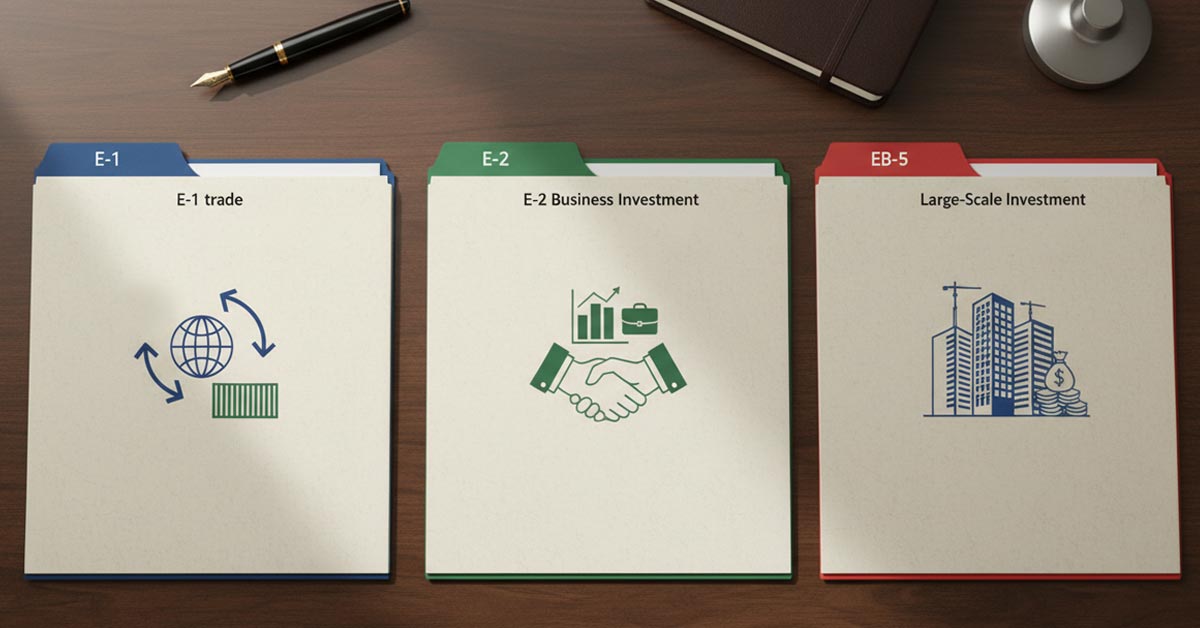
Acquiring an existing business, by contrast, is generally lower-risk at the decision stage because it establishes marginality proof through "historical data"; three years of tax returns and an existing payroll show the business is non-marginal without relying on projections. If the investor is still deciding between investment visa routes, our E-1, E-2, and EB-5 comparison guide clarifies which path fits their profile; the article addresses business selection for the investor who has decided to stay with E-2.
Strong Sectors for E-2 and Business Models to Avoid
Whether a sector counts as "strong" for E-2 depends on how naturally that sector passes the marginality and "real and active enterprise" tests. If the business model strains these tests, even the best legal preparation cannot fully cure the structural disadvantage.
Strong models for E-2:
- Franchise businesses: The most predictable path. The Franchise Disclosure Document (FDD) and proven unit economics provided by the franchisor make the five-year business plan documentable in the officer's eyes. Even a newly opened franchise largely overcomes the "speculative" objection thanks to brand history.
- Established service and retail businesses: Businesses with an active customer base and steady cash flow naturally satisfy marginality.
- Logistics, light manufacturing, and distribution: Employment-intensive and revenue-scalable models are strong. For a sector-specific example, see our E-2 and trucking investment guide.
- Restaurants and food and beverage: A common choice, but one that requires care; the business must be able to grow from a single-location structure that only supports the owner into a scale that employs staff.
Even when a franchise is chosen, due diligence should not be relaxed. Item 19 of the franchisor's FDD (the financial performance representation) and the actual revenue data of existing operating franchisees should be reviewed, and the market saturation of the selected territory assessed. On the restaurant and food-and-beverage side, choosing a concept with clear growth and employment potential from the outset, rather than a single small location, markedly reduces marginality risk.
Models to avoid or treat as high-risk:
- Passive real estate: Buying property for rental income is not E-2-eligible; it is not a "real and active commercial enterprise" but a passive investment.
- Speculative or idle investments: Investments not yet operational and awaiting development do not meet the "active enterprise" threshold.
- Single-person consultancies with no staff: Small consultancies that only support the investor's living and create no employment carry direct marginality-denial risk.
Business Valuation and Due Diligence: An Investor's Checklist
Once a business is selected, the step that protects both the purchase decision and the E-2 file is valuation and due diligence. The investment amount being deemed "substantial" depends on the price paid being consistent with the genuine market value of the business; for this reason, an independent business valuation and a written Asset Purchase Agreement are prepared.
If an existing business is being acquired, the following due diligence checklist should be completed before the decision:
- The last three years of tax returns, profit and loss (P&L) statements, and the balance sheet
- Transferability of the lease or the terms of a new lease agreement
- Staff roster, payroll records, and continuity of employment
- Business licenses, permits, and sector-specific authorizations
- Existing debts, liens, and any open litigation or enforcement records
- Customer and supplier contracts, and dependency risks
One of the core principles of E-2 is that the investment capital must be "at risk" and "irrevocably committed"; that is, the funds must be actually transferred to or committed to the business. A common solution that protects the investor is holding the capital in an escrow account conditioned on visa approval and releasing it upon approval; this arrangement is accepted under E-2 standards. How the application proceeds step by step once business selection is complete is explained in our guide on how to obtain an E-2 visa.
The lawful source of the investment capital is the section of the file prepared with the most care once the business is selected. For Turkish investors, the source may be savings, the sale of real estate, an inheritance, company dividends, or a loan, each requiring a documentable money trail (bank statements, sale agreements, tax records). For businesses built from scratch, a five-year business plan must also be prepared with realistic revenue and employment projections; this plan is not a formality but the core evidentiary document for the marginality test.
Yellow Law Group's five-state office structure puts legal support near the region where the investor will establish the business: the Plano (Texas) headquarters, Chicago (Illinois), Irvine (California), Alpharetta (Georgia), and the Fairfield (New Jersey) partner office. The handshake in our logo symbolizes the foundation of the partnership built with the client; our attorney team's 10 years of collective practice reflects the same approach. To evaluate whether your business selection meets E-2 criteria before applying, you can work with our Texas Bar licensed attorneys and schedule a 30-minute initial consultation through our contact page.