
Investing in America can, through the right route, be a door to permanent residence (a green card) in the US. This guide answers two questions at once. If you have investable capital and are asking whether it can bring a green card, here you will find which investment turns into permanent residence. If you want permanent residence and wonder whether investment is a real path, we cover which route leads directly to a green card. At the center is the EB-5 investor green card; alongside it are EB-1C, EB-2 NIW, and, as a stepping stone, E-2. We go through the investment amounts, the process, priority dates for Turkey, and proving the source of funds in turn. It is general information, not legal advice.
What Investment Yields: A Green Card or an Investment Visa?
The first distinction must be clear, because not every investment route gives a green card. A green card is permanent residence: the right to live and work indefinitely, derivative status for a spouse and children under 21, and a basis that leads over time to citizenship. An investment visa, such as the E-2, is a temporary status; it renews as long as the business continues but does not by itself turn into permanent residence. Only some of the investment-related routes lead directly to a green card; others first give a temporary status and then bridge to permanent residence through a separate petition. We have a separate investment visas guide that compares which investment visa serves which purpose; this page focuses on the permanent-residence outcome.
The Four Routes to a Green Card Through Capital
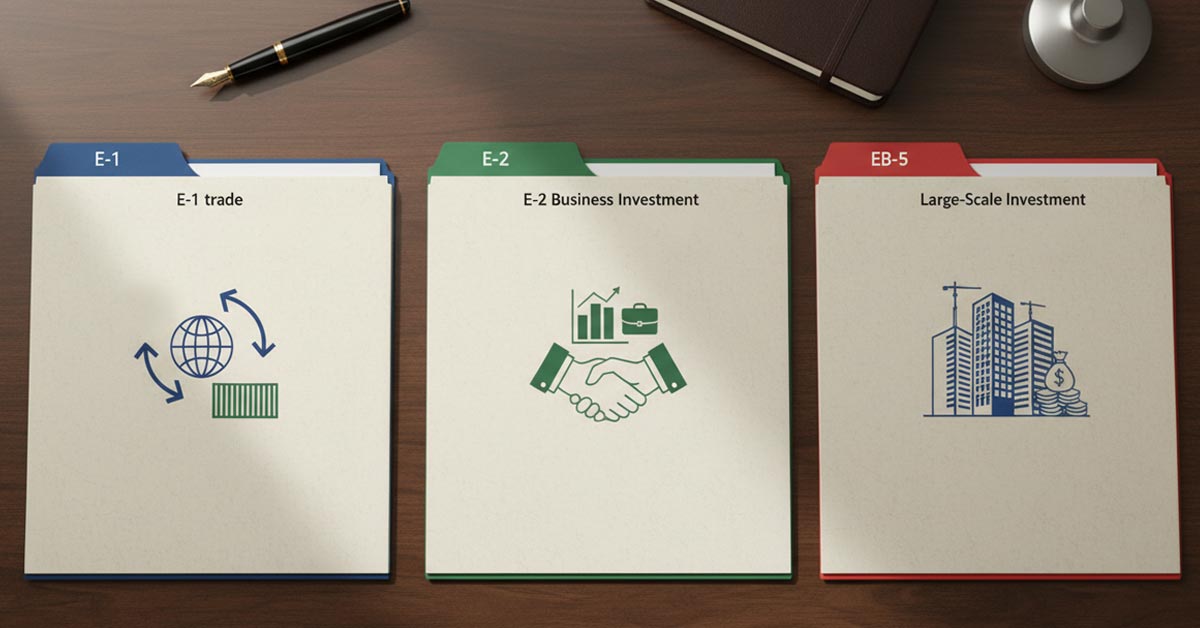
There are four main routes from investment to permanent residence, and only one is, in the pure sense, a "direct green card for capital." The EB-5 investor program opens a direct green card path for a person who invests a set amount at risk and creates ten jobs; it is the flagship route of this guide. The EB-1C multinational manager route requires no fixed investment amount but needs a genuine cross-company structure and a managerial role; it often begins with an L-1A transfer first. The EB-2 NIW allows a self-petition, without a capital threshold or an employer, through an endeavor of national importance. The E-2, in turn, gives no permanent residence; it is a temporary investor visa that provides a fast entry and only later bridges to the other routes. We cover each below in turn.
EB-5: A Direct Green Card for Capital (the Flagship Route)
The EB-5, grounded in Section 203(b)(5) of the immigration law and the 2022 Reform and Integrity Act (RIA), is the direct investor green card. You can review the official framework on the USCIS EB-5 page. There are two investment amounts: a standard threshold of $1,050,000, and $800,000 in a targeted employment area (TEA). A targeted employment area can be a rural area, a high-unemployment area where unemployment is at least 150% of the national average, or an infrastructure project. The investment must create at least ten full-time jobs for qualifying US workers and must be fully at risk, that is, genuinely subject to both gain and loss; a guaranteed return or a redemption right breaks that requirement. The investor's spouse and children under 21 also receive green cards. There is an important point on timing: the law provides that these amounts be adjusted for inflation every five years, and the first adjustment takes effect on January 1, 2027. After that date the $800,000 tier is expected to rise noticeably; so for investors planning to use the current amount, the calendar is a real factor.
How the EB-5 Works: From Petition to a Conditional Green Card to Removing Conditions
The process begins with a petition. For regional-center investments, Form I-526E is filed; for a direct investment, Form I-526; both document the source of funds and the job-creation plan. An important convenience the RIA introduced is this: an investor lawfully present in the US may, if a visa number is available, file the I-485 adjustment of status together with the petition and obtain work and travel authorization while the case is pending. Applicants abroad complete consular processing with the DS-260. Approval grants a two-year conditional green card. In the ninety-day window before the second year is complete, Form I-829 is filed to prove that the investment was sustained and the jobs were created; when approved, it leads to an unconditional, ten-year green card. The RIA also reserves a portion of the annual EB-5 visas for rural, high-unemployment, and infrastructure projects; these reserved categories provide a clear advantage on priority dates.
Direct Investment or a Regional Center?
The EB-5 has two basic structures, and the choice makes a difference for both control and the proof of job creation. In a direct investment, you set up and run your own enterprise; but only real, full-time jobs on your payroll count toward the ten-job requirement. In a regional-center investment, you place your funds in an approved project and are often a passive partner; on this route, indirect and induced jobs can also be counted through accepted economic methods, which is why most investors prefer the regional center. Which structure fits you depends on whether you want to run the business yourself, your risk preference, and the nature of the project. We cover the depth of project selection and eligibility assessment in our EB-5 investor visa service.
Proving the Lawful Source of Funds: Notes for the Turkish Investor
The part of the EB-5 that takes the most work is often not the investment itself but documenting the lawful source of the funds in a traceable way. USCIS wants to see where the money came from and by what path it flowed to the investment. For someone investing from Turkey, this means presenting income-tax records, the amount from a sale of real estate or a company, inheritance or gift documents, and the bank records of the foreign-currency transfer from Turkey as a consistent chain. Showing transactions in Turkish lira and the currency conversions clearly is the part of the file that demands the most care. Building the source correctly from the start is the safest way to avoid a later request for evidence; we assemble the file so the proof is in the order the officer looks for.
EB-1C and EB-2 NIW: Alternatives Without a Capital Threshold
A green card through investment is not only the EB-5; there are two more routes without a capital threshold. The EB-1C multinational manager route suits an owner who already has an active company abroad and wants to set up and run a US affiliate; there is no fixed investment amount, but a genuine cross-company structure and a managerial role are required, and most files begin first with an L-1A transfer. The EB-2 NIW, in turn, lets you self-petition without capital or an employer, through an endeavor of national importance; the measure is not money but the importance of your endeavor and your capacity to advance it. For investors whose capital does not reach the EB-5 threshold but who have a strong business or venture, these two routes are often the right question.
E-2 as a Stepping Stone: A Fast Entry First, Then a Green Card Bridge
The E-2 treaty investor visa gives no permanent residence but can be a strategic start. Turkey is among the E-2-eligible countries through a 1933 treaty; there is no fixed minimum amount, the investment must be substantial relative to the business, and the process moves faster than the EB-5. Many investors first set up or buy a US business on E-2, test the market, and then, by growing their capital and business, bridge to the EB-5 or, through a managerial structure, to the EB-1C. We have an E-2 to green card transition guide that covers in detail why the E-2 is not permanent and the mechanics of moving to a green card; this page positions the E-2 only as a strategic stepping stone.
Priority Dates for Those Born in Türkiye and the Visa Bulletin
The priority-date picture points to a better position than many investors expect. Türkiye is not among the countries subject to a separate quota in the EB-5; only those born in China and India face a retrogressed category. On the July 2026 Visa Bulletin, for an investor born in Türkiye, both the general (unreserved) EB-5 category and the three reserved categories, that is, rural, high-unemployment, and infrastructure, are current. The practical meaning is this: an investor born in Türkiye faces no waiting queue in any EB-5 category right now; if in the US they can file the adjustment of status together with the petition, and if abroad they can move to consular processing. The reserved categories serve as insurance: if the general category retrogresses later, the smaller, less-demanded reserved pools are expected to stay current. Because the Visa Bulletin changes month to month, we assess the current picture based on your file.
Cost, Time, and Risks: Realistic Expectations
A green card through investment is a strong route when built correctly, but it is not guaranteed. In the EB-5 the entire investment is at risk; if the project fails, both the capital and the petition can be jeopardized, which is why the choice of the project and the regional center matters as much as the immigration file. The timeline varies by category and by where the application is made; the reserved categories and concurrent filing can shorten the process, but giving an exact date is not realistic. Beyond the investment amount, legal fees, regional-center costs, and government fees are separate items. Choosing the right route means assessing your profile as a whole rather than relying on a single path; we also have a general green card routes guide that compares all twelve green card paths.
Build Your Investment-Based Green Card Process With Yellow Law Group
In a green card through investment, the right decision is often not only how much you invest, but which route fits your capital, your timeline, and your goal. Yellow Law Group, from its headquarters in Plano (Texas) and offices in Chicago (Illinois), Irvine (California), Alpharetta (Georgia), and Fairfield (New Jersey), determines the right route among the EB-5, EB-1C, EB-2 NIW, and E-2 based on your capital and profile, builds the lawful source of funds in the order the officer looks for, handles the petition and the green card stage, and stands with you with an independent eye on project selection.
We move the process in line with current developments, in Turkish and English. You can review our attorneys on our team page and schedule a free initial consultation through our contact page to discuss your investment eligibility and your green card options.