As of 2026, sponsoring a foreign spouse, parent, child, or sibling to the United States as a U.S. citizen or lawful permanent resident moves through six federal stages from start to citizenship: INA §201-203 relative classification, Form I-130 sponsorship petition, State Department Visa Bulletin priority sequencing, AOS (Form I-485) or consular processing, conditional green card to permanent status via Form I-751, and finally Form N-400 naturalization. Yellow Law Group, headquartered in Plano (Texas) with offices in Chicago (Illinois), Irvine (California), Alpharetta (Georgia), and Fairfield (New Jersey), has guided international families through these six stages with 10+ years of collective attorney experience. The pillar walks each stage in order; it identifies which individual immigration service category covers each.
Roadmap: The 6 Stages of Family Immigration
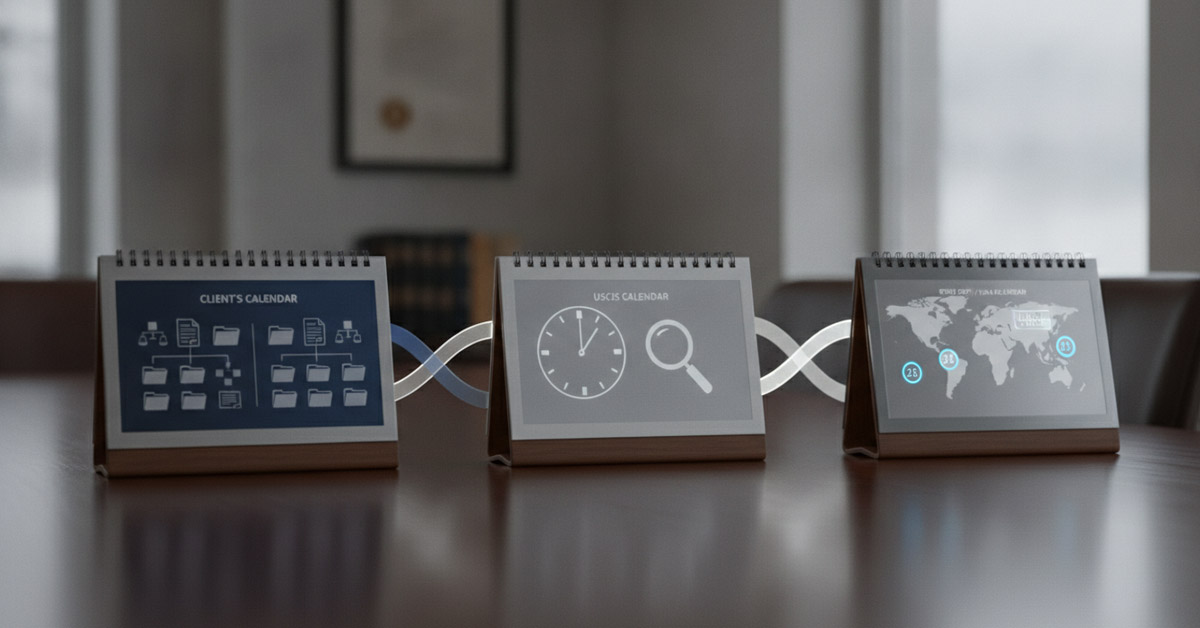
The map below condenses the lifecycle from relative classification to U.S. citizenship. Each row lists the stage, its federal trigger, and the Yellow Law service that handles it. Subsequent sections open each stage in detail.
| Stage | Legal Trigger | Yellow Law Service |
|---|---|---|
| 1. Relative & Category Selection | INA §201 (Immediate Relative) / §203 (F1-F4) | Family reunification |
| 2. Form I-130 Sponsorship | 8 CFR 204.2, USCIS Form I-130 | Marriage green card |
| 3. Visa Bulletin Waiting | INA §202 country cap, DOS Bulletin | Sibling visa (F4) |
| 4. AOS (I-485) vs Consular Processing (CP) | INA §245, DS-260 + NVC | Parent visa |
| 5. Conditional Status & I-751 | INA §216, Form I-751 | Child visa |
| 6. N-400 Naturalization | INA §316, Form N-400 | N-400 Applications |
When all six stages run through one legal team, the sponsor manages every renewal date, interview prep, and status change from a single point. The most common loss in a fragmented model: failing to update an I-130 when the sponsor naturalizes mid-wait, missing the I-751 90-day window after a conditional green card, or skipping a travel-history review before N-400 filing.
Stage 1: Relative Classification and Category Choice (IR vs F1-F4)
The journey to bring a foreign relative to the United States begins at the intersection of the sponsor's status (USC or LPR) and the relationship type. INA §201 separates one category from the other four: Immediate Relative (IR) status.
- Immediate Relative (no numerical cap): A U.S. citizen's spouse (IR-1), unmarried child under 21 (IR-2), and parent (IR-5). No waiting; the category never fills.
- F1, USC's unmarried 21+ child: Capped annually; current wait roughly 7-9 years (including Turkey).
- F2A, LPR's spouse and unmarried under-21 child: Generally current in 2026.
- F2B, LPR's unmarried 21+ child: Wait around 6-7 years.
- F3, USC's married child: Wait roughly 13-14 years.
- F4, USC's sibling: Longest wait, 14-16 year band.
If the sponsor is an LPR, only F2A and F2B are available; parent and sibling sponsorship require U.S. citizenship. When a sponsor advances from green card to citizenship, a pending F2A petition automatically upgrades to IR-1; the mechanics and benefits are covered in our F2A -> IR-1 upgrade guide.
A foreign spouse's prior violations, previous marriage records, or U.S. entry-exit history can shift category eligibility. For strategic category placement, our family reunification service evaluates the sponsor and the foreign relative together.
Stage 2: Form I-130 and the Family Sponsorship Petition
Once the relationship is confirmed, Form I-130 filed with USCIS records the sponsorship relationship and starts the priority date. The 2026 USCIS filing fee is USD 675, with online or paper filing options. Different evidentiary sets are required depending on the relationship type:
- For spouses: Marriage certificate, bona fide relationship evidence (joint bank statements, lease agreement, photo timeline, travel records).
- For parents: Birth certificate, proof that parents were married at the sponsor's birth (otherwise legitimation evidence).
- For children: Birth certificate, declaration of single status, adoption decree if applicable.
- For siblings: Passport or birth certificate of at least one common parent for both sides.
After I-130 approval, the case splits into two tracks: if the foreign relative is outside the United States, the file moves to the National Visa Center (NVC) for consular processing; if inside, it usually drops onto the AOS (Form I-485) line. If the sponsor naturalizes during this period, the category upgrades to IR; our F2A -> IR-1 upgrade article opens this transition mechanically.
Stage 3: Visa Bulletin Waiting and Priority Dates
In the IR category there is no waiting; in F categories, the priority date must be "current" in the State Department's monthly Visa Bulletin. The Bulletin opens two columns: Final Action Date (visa issuable) and Date for Filing (NVC requests documents while the visa still waits).
For family-based categories, Turkey sits in the "Rest of the World" list. As of 2026, the current wait bands are: F1 ~9 years, F2A current, F2B ~7 years, F3 ~14 years, F4 ~16 years. These figures are longer for China, India, the Philippines, and Mexico because of the per-country cap under §202(a)(2).
How to read the Visa Bulletin, column differences, and retrogression risk are walked step by step in our Visa Bulletin reading guide. During the wait years, sponsor death, bankruptcy, divorce, or the foreign child crossing age 21 (CSPA mechanics) often transforms the case; for active monitoring of these changes, our child visa service and sibling visa service provide category-based support.
Stage 4: AOS (I-485) vs Consular Processing (CP) Strategic Choice
Once a visa number becomes available, the case can move to one of two administrative tracks. The choice depends on where the foreign relative currently is, what status they hold, and prior violation history.
- Adjustment of Status (AOS, Form I-485): If the foreign relative is inside the United States, entered with a valid nonimmigrant status, and qualifies under INA §245(a), they can adjust to a green card without leaving the country. For spouses, bona fide marriage evidence, the financial sponsor form (I-864), medical exam (I-693), work authorization (I-765 EAD), and travel permission (I-131 Advance Parole) are filed alongside.
- Consular Processing (CP): If the foreign relative is outside the United States, the NVC packet is completed and the candidate is called for a DS-260 interview at the U.S. embassy or consulate in their home country. After visa stamping and entry to the United States, the green card activates; the physical card arrives in 60-90 days.
The strategic decision sharpens by comparing AOS's dual filing right (parallel AOS plus nonimmigrant status during pendency) against CP's faster visa stamping window. Spouse-specific scenarios are covered in our marriage-based green card service; parents arriving on B-2 tourist visas and then filing AOS are addressed in our parent visa service page. The K-1 fiancé(e) visa runs through a special alternate path at this stage and falls under our K-1 fiancé(e) visa service.
Stage 5: After the Green Card, Conditional Status and I-751
Couples whose marriage date is less than 2 years before I-485 approval receive a conditional green card (CR-1) with a 2-year validity. Within the 90-day window before card expiration, Form I-751 must be filed to remove the conditions; failure terminates the status and triggers removal proceedings.
I-751 is filed jointly with the spouse, but in exceptional cases, it can be filed unilaterally with a waiver request:
- Divorce waiver: The marriage was genuine but ended after entering in good faith; INA §216(c)(4)(B).
- Battery waiver: Under VAWA protection; from spouse or parent.
- Extreme hardship waiver: Severe hardship if removed; rarely used.
- Spouse death: Joint petition impossible, so the waiver path applies.
After I-751 approval, the green card converts to a standard 10-year LPR status. A significant advantage for spouses of U.S. citizens with green cards: if the 3-year rule is satisfied, N-400 can be filed at 3 years instead of 5 (INA §319(a)). The technical mechanics of I-751, the evidence file, requests for evidence, the interview, and the stage after a denial are covered in our conditional green card and I-751 guide.
Stage 6: N-400 Naturalization and Dual Citizenship
An LPR who completes the 5-year residency (3 years for spouses of USCs), the required physical-presence rules, and the good moral character standard may file Form N-400 for U.S. citizenship. As of 2026, the N-400 fee is USD 760 online / USD 710 paper. The process requires four legs:
- N-400 application: Form, fee, biometric appointment. Our N-400 application service guides the applicant through the online portal.
- Civics test: 10 questions drawn from a 100-question standard pool, 6 correct required. Preparation through our citizenship interview preparation service gives access to the template pool.
- English proficiency: Speaking, reading, writing; exemption for 65+ years and 10+ years LPR (50/20 rule).
- Naturalization interview: Form questions plus Civics plus English combined; if failed, a re-interview right within 60-90 days. Our citizenship interview preparation service simulates the template questions and nodal decisions in advance.
If N-400 is denied, Form N-336 grants USCIS-internal appeal rights within 30 days; if that also fails, a de novo federal action under §1421(c) is the next step. Strategy for denied applications sits under our N-336 appeals service.
A critical question often asked by international couples: does U.S. citizenship cancel home-country citizenship? Many countries (including Turkey) accept dual citizenship; the United States places no general statutory prohibition either. The USCIS posture and the tax compliance technique under IRS FATCA obligations for dual citizens run through our dual citizenship service.
International Family Sponsorship: Localized Notes for Multi-State Coverage
International family files often need updates in three places: consular logistics, document standards, and multi-state coverage. Our Texas Bar licensed attorneys bridge U.S. federal law with foreign civil codes (spouse, marriage, divorce, custody). The handshake in our logo reflects the partnership philosophy with the client; our attorney team's 10+ years of collective practice rest on the same foundation.
- Consular appointments: If the foreign relative is in the home country, the DS-260 interview happens at the relevant U.S. embassy or consulate; the 2026 lead time is roughly 4-9 months.
- Document translation and apostille: All foreign marriage, birth, and divorce certificates require USCIS-standard English translation and, if required, apostille certification. Yellow Law's internal partner network accelerates translation and authentication.
- Sponsor across multiple states: The sponsor's state of residence affects the I-864 financial-sufficiency calculation. From our Texas, Illinois, California, Georgia, and New Jersey offices, we prepare income documentation properly.
- Naturalized Turkish-American sponsor: When a sponsor becomes a USC, sponsorship authority opens for children and parents; our family sponsorship roadmap intake places this new authority on the roadmap correctly.
Family immigration is a structure spanning 5 to 16 years; when run by one legal team, the risks at every stage disappear. The relationship begun at our firm continues through naturalization approval. Schedule a 30-minute evaluation call; we place the sponsor and the foreign relative on the 6-stage roadmap together.